


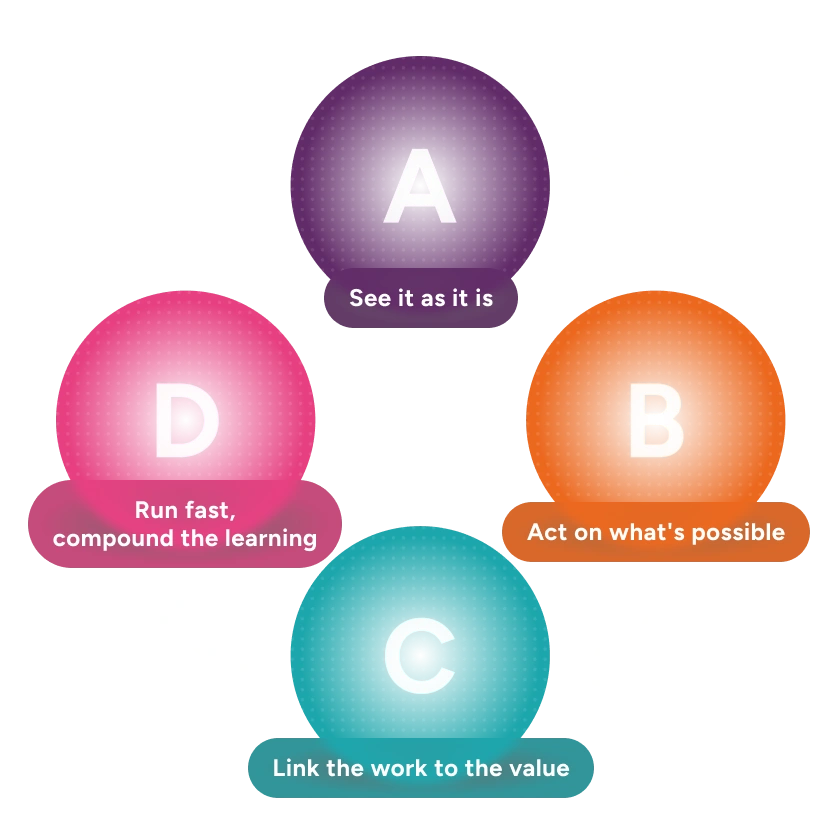
The ABCD Values are not just a mindset. They set out how each of us embodies
the way of working that keeps the company growing.
They are not four separate guidelines;
they connect as four roles that together support a single motion.

© 2026 ABCD inc.
Careers Culture
 Our Values
 The ABCD Values are not just a mindset. They set out how each of us embodies
the way of working that keeps the company growing.
They are not four separate guidelines;
they connect as four roles that together support a single motion.
Exceed expectations —
One step higher, One step faster.
Question your own map. Look straight at the gap between reality and how you see it.
Capture the gap between the ideal and reality precisely, and ask again whether this structure is the right one in the first place.
Keep updating your own assumptions by learning from others openly, acknowledging what they see and taking it in.
The moment you think "that is just how it is" is the sign that your map has gone out of date.

Behaviors We Value
Do not hide behind constraints. Ask how we can do it.
Instead of raising real constraints and difficulties as reasons we cannot, keep asking How can we? If avoiding something is the right call, choose it. But never turn that into an excuse for not doing it. Bring your energy, and go build a workable path yourself.

Behaviors We Value
Create an experience, not a feature. Make it count where customers really pay for value.
Judge by whether the customer experience gets better, not by whether we can build it. Adding a feature is never the goal in itself; design by going back to what the customer really wants to get done behind it. Value built up reliably, piece by piece, is what becomes unshakable trust.

Behaviors We Value
Run the loop fast and compound the learning. Step by step, faster and better than before.
Act early above all, and learn as you keep going. Turn each cycle fast so that learning compounds, overwrites fixed assumptions and creates a new order. Do not let the learning end with you; turn it into the starting speed of the next loop.

Behaviors We Value
OKR At ABCD we use OKR as our method for setting and managing goals.
OKR stands for Objectives and Key Results, a framework for setting and managing goals.
You set two elements — the Objectives you want to reach, and the Key Results that mark the milestones toward them — and review them frequently, which makes it possible to reach large goals efficiently.

So that goals do not end the moment they are set, we hold regular conversations on a weekly, monthly and quarterly cadence.
Through these meetings we check progress and correct course, cycle after cycle.
 Work Style
 Flextime (core hours: 10:00-17:00)
Two days off every week (Saturday and Sunday), national holidays, year-end and New Year holidays, paid leave, condolence and congratulatory leave, 125 days off per year
Two days a week or more in principle, open to discussion depending on your work and its phase
Full social insurance (health insurance, employees' pension, employment insurance, workers' accident compensation insurance)
Commuting costs covered in full
Work-from-home program
Training programs
Book purchase support
Contents 